
Engineering Commercial Fusion
A compact path to net fusion power
Kinetic Fusion is developing a compact hybrid fusion reactor for "real world applications." Our goal is to make fusion power practical and commercially viable.
Hybrid
A hybrid approach that combines multiple proven nuclear fusion technologies to leverage the unique strengths and advantages of each.
Compact
The hybrid reactor employs an efficient confinement architecture, enabling a compact design with a 2.5 m vacuum vessel and first-wall diameter.
Commercial
Designed for practical deployment, with manufacturability, scalability, and operation considered from the outset.
Nuclear Fusion
The Physics
Fusion is the process that powers the Sun and is widely regarded as the long-term future of clean energy. By fusing light atoms together, nuclear fusion will produce abundant, reliable, low-carbon electricity from widely available fuel.
Unlike conventional nuclear power, which splits atoms (fission), fusion combines atoms to release vast amounts of energy. The result is a cleaner, inherently safer energy source with no risk of runaway chain reactions and significantly less long-lived radioactive waste.
Kinetic Fusion uses deuterium-tritium (D–T) fuel, the leading choice for commercial fusion. These two forms of hydrogen fuse to produce helium and a high-energy neutron, whose energy is converted into usable electricity.
The Hard Part: Confinement
Many nuclear fusion approaches require the fuel to reach extremely high temperatures and densities. To achieve this, the fuel is converted into a plasma, the fourth state of matter, where electrons are stripped from the deuterium and tritium atoms. No material can withstand direct contact with plasma at these temperatures, so it must be confined without touching the reactor walls.
The two most common approaches are magnetic confinement, which uses powerful magnetic fields to contain the plasma, and electrostatic confinement, which uses electric fields to accelerate and confine charged particles. Most fusion systems rely on one or the other. We combine both in a hybrid approach, leveraging the strengths of each.
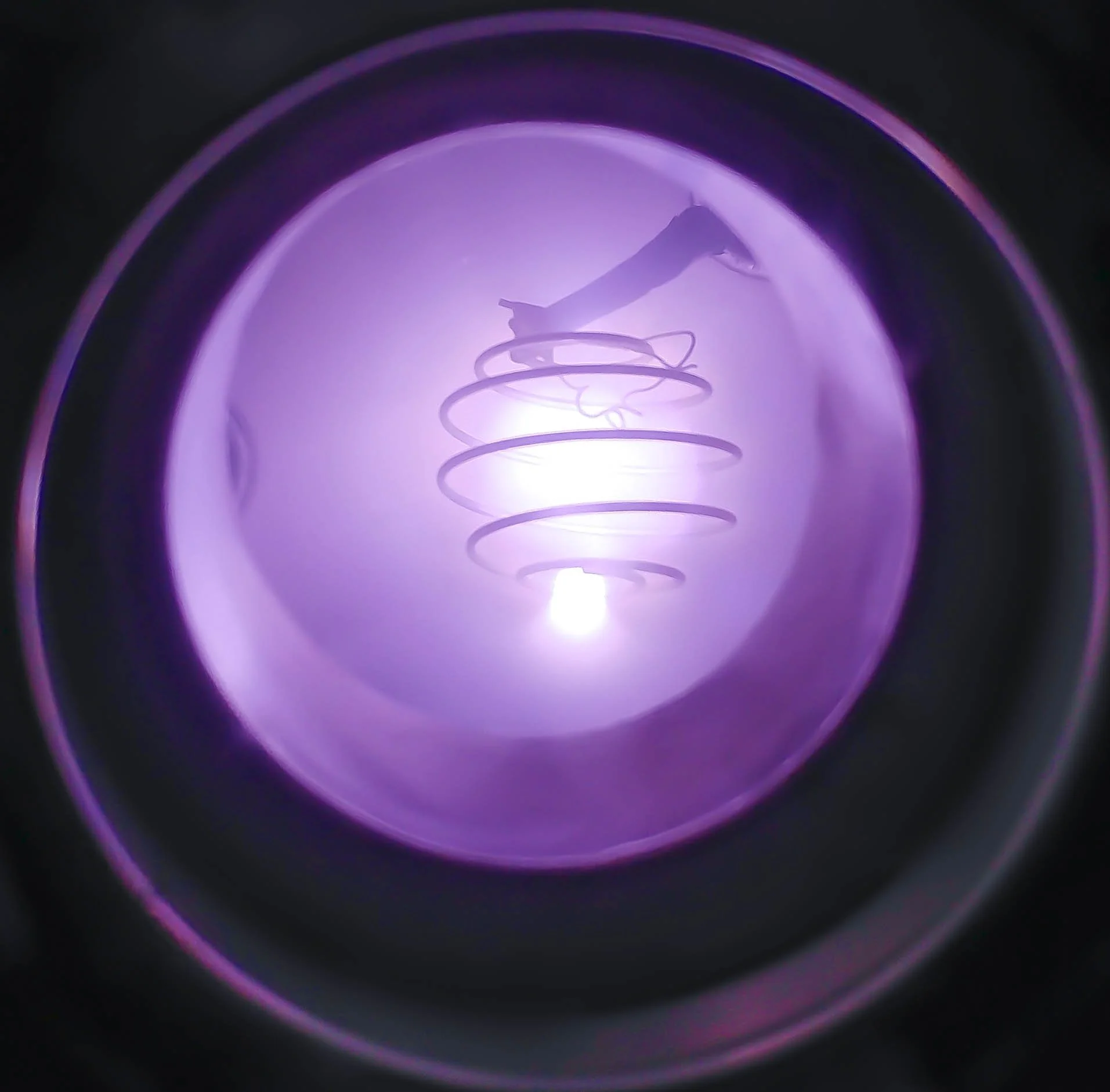
Hybrid Reactor
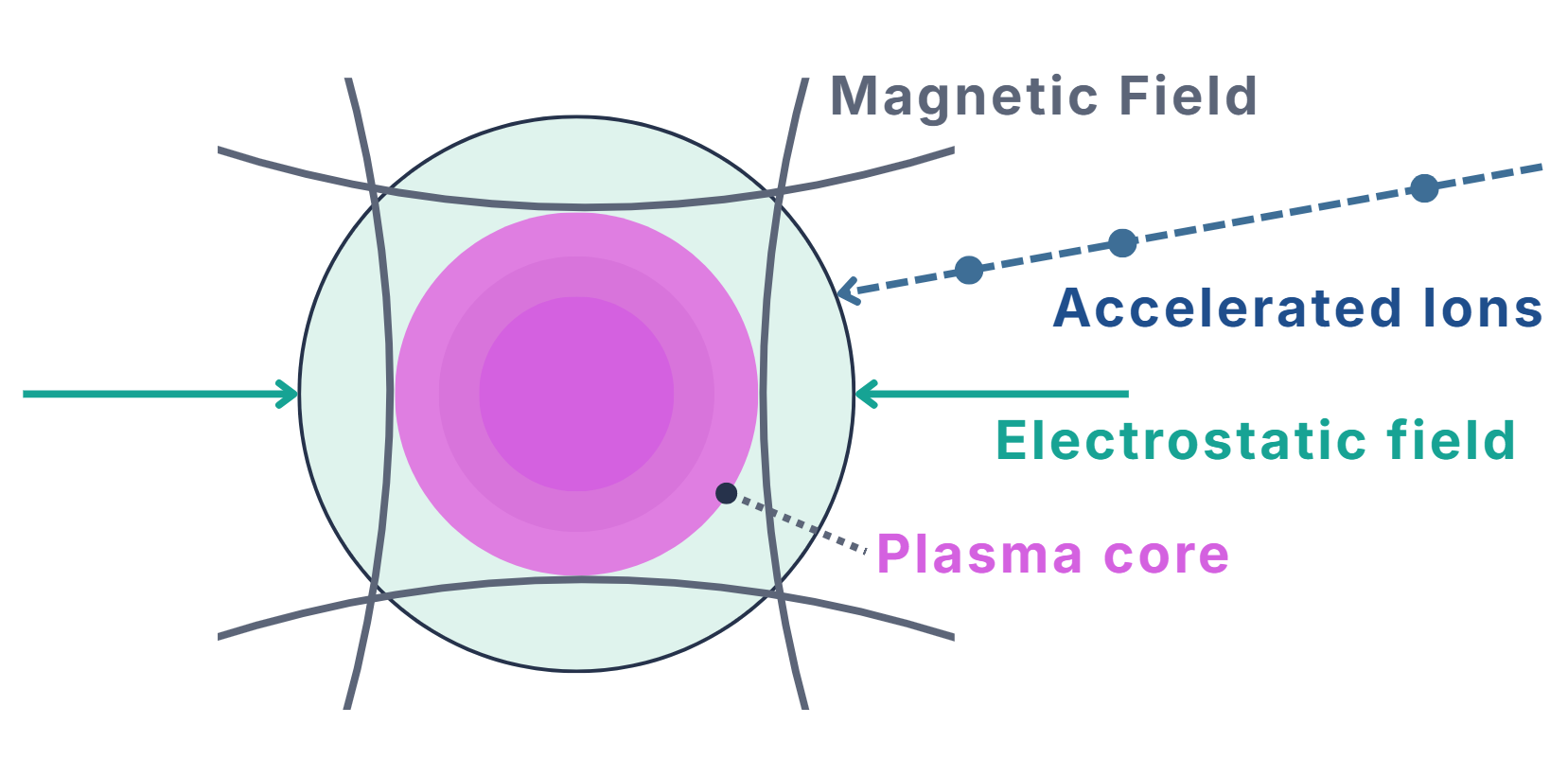
Illustrative concept only, IP disclosure, not an engineering schematic.
Kinetic Fusion is developing a compact hybrid fusion reactor that combines magnetic confinement, electrostatic confinement, and accelerator-driven fuelling into a single system. We believe this combination is key to making compact, commercially viable fusion power possible.
Most fusion programmes pursue ever-larger reactors to achieve net energy gain, resulting in complex, capital-intensive projects with long construction timelines.
We're taking a different approach: a compact reactor with a vacuum vessel and first-wall diameter of around 2.5 m. The result is lower capital costs and a shorter path to commercial deployment.
Controlling the fuel
A cloud of electrons forms a deep, self-sustaining electric potential well, a virtual cathode, that draws ions inward and holds them in place at the core of the reactor.
Supporting the reaction
Magnetic cusp fields, generated by high-temperature superconducting magnets, work with the electrostatic potential well (virtual cathode) to achieve the high-beta conditions needed for stable plasma confinement.
Driving the reaction
Accelerator technology delivers and replenishes the D–T fuel, sustaining the reaction that the combined electrostatic and magnetic confinement holds in place.
Why It Works
Tuned for reactivity
D–T collisions in our design reach a centre-of-mass energy of around 100 keV, close to the peak of the D–T reactivity curve, where fusion is most likely to occur.
Fewer losses
At 100 keV, the electron gyroradius is small enough that electrons stay tightly magnetized almost everywhere in the reactor, except at the field-null core, keeping energy losses low.
Built compact
Higher beam energy increases fusion power density, shrinking the plasma core to around 1.7 m in diameter. This enables a compact reactor design, with a vacuum vessel and first wall measuring approximately 2.5 m in diameter.
Building Commercial Fusion
Our development pathway starts with a single system: the accelerator. First, we build it. On its own, it is a high-yield neutron source for producing medical isotopes, creating a commercial product that can generate revenue years before a reactor exists. Then, that same accelerator design becomes a core subsystem of the hybrid reactor itself, so the engineering we prove commercially is the same engineering the reactor depends on.
The Four-Stage Pathway
Accelerator system
Build and commercialise the accelerator as a standalone neutron source for medical isotope production. The same design later forms a core subsystem of the hybrid power reactor.
System integration
Combine accelerator technology with electrostatic and magnetic confinement approaches to create a complete hybrid reactor architecture.
Hybrid reactor
Demonstrate a compact fusion reactor design that combines multiple confinement technologies into a commercially practical system.
Commercial fusion power
Deliver a scalable fusion energy system capable of producing more energy than required to sustain the reaction, enabling practical power generation.
Let’s talk fusion
Whether you are interested in our technology, exploring collaboration opportunities, or want to learn more about our approach to commercial fusion, we welcome conversations with partners, researchers, and industry professionals.
Get in touch to discuss how we are working to advance compact hybrid fusion technology toward commercial deployment.